

"AI+" in Gov't Work Report for 3rd Straight Year: Lawmakers Urge Faster Rollout of Robotaxis Like Apollo Go
Source: China Daily/REN MIN YOU DIAN
On March 5, the Fourth Session of the 14th National People's Congress opened in Beijing. The 2026 Government Work Report proposed fostering new forms of intelligent economy. Deepening and expanding “AI+” will accelerate the promotion of next-generation smart terminals and intelligent agents, drive large-scale commercial application of AI in key industries, and cultivate new AI-native business models and formats.
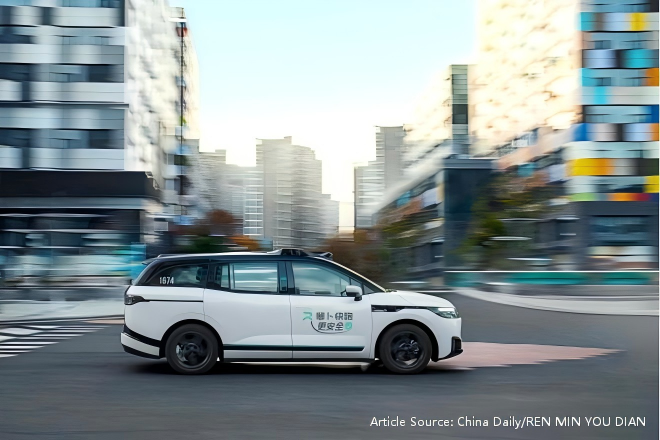
How can “AI+” truly take root and flourish in the transportation sector? During this year's Two Sessions, accelerating policy deregulation for autonomous driving and promoting its large-scale implementation emerged as a focal point of concentrated calls from delegates and committee members. From unifying national access standards and streamlining testing, operation, and licensing approvals to breaking down regional barriers and achieving “one certification, multiple locations”; from batch-opening cities for fully driverless commercial operations to supporting platforms like Apollo Go and building metropolitan application clusters—a series of proposals point to a common goal: fostering truly sustainable driverless business models and enabling China's new intelligent economy to seize the initiative in global competition.
Meanwhile, Minister of Industry and Information Technology Li Lecheng stated during the first “Minister's Channel” press conference at the Fourth Session of the 14th National People's Congress that by 2026, the Ministry will vigorously advance the “two-way convergence” of artificial intelligence (AI) and manufacturing, as outlined in the Government Work Report. China boasts a comprehensive industrial base, abundant innovative talent, and a continuously improving innovation ecosystem. We are confident that more world-class intelligent products will emerge from this fertile ground. We will strive to advance AI computers, AI smartphones, and smart home devices to better meet people's aspirations for a better life, while fully promoting scientific breakthroughs and technological iterations in next-generation AI products—including brain-computer interfaces, autonomous vehicles, and humanoid robots.
“Intelligent native applications, exemplified by autonomous driving, represent an advanced form of deep integration between the digital economy and the real economy. They serve as a crucial engine for driving industrial transformation and upgrading while unlocking new growth potential. China's technological capabilities have achieved global parity and possess the conditions to lead in large-scale implementation and establish industrial advantages. However, challenges remain, including the need for revisions to higher-level laws, innovative pilot policies, expanded application scopes, and coordinated efforts in technological iteration and workforce transformation.” Zhao Xiaoguang, a member of the National Committee of the Chinese People's Political Consultative Conference and a researcher at the Institute of Automation of the Chinese Academy of Sciences, suggested designating new industries like autonomous driving as key future sectors and accelerating the development of targeted policy support systems. This includes expediting legislative research, optimizing pilot policies, and providing policy space for early trials; expanding application scenarios to support implementation in diverse settings; and strengthening talent support to facilitate transformation and adaptation.
Fu Zitang, NPC deputy, professor at Southwest University of Political Science and Law, and chair of the Legal Affairs Committee of the Chongqing Municipal People's Congress, proposed accelerating revisions to the Road Traffic Safety Law to establish the “legal status” of driverless vehicles and shift liability logic to accommodate autonomous driving. This would reduce compliance costs and build social trust. He also advocated intensifying pilot demonstrations by selecting qualified metropolitan areas to create globally influential autonomous driving application clusters and deepen applications in multi-dimensional spatial scenarios. Support the scaled development of autonomous driving, encourage expanding service coverage in scenarios such as airports, high-speed rail stations, industrial parks, and urban micro-circulation networks, and explore personal vehicle models to serve public transportation needs.
Wu Renbiao, NPC deputy and Vice President of Civil Aviation University of China, believes autonomous driving serves as a crucial foundation for the all-space unmanned system. Currently, China holds a leading position in both drone technology and industry, while ground-based autonomous driving has emerged as a quintessential example of new productive forces.
Leading domestic autonomous driving platforms like Apollo Go have launched operations in 26 cities worldwide, accumulating over 20 million ride-hailing trips and establishing themselves as a globally leading autonomous mobility service provider. Wu Renbiao asserts that this practice fully demonstrates autonomous driving technology has achieved the maturity required for large-scale implementation. He noted that scaling up autonomous driving can cultivate industrial ecosystems and enhance public confidence in safety. Its relatively safe risk-avoidance strategies and widespread accessibility can gradually increase public acceptance of unmanned systems, laying the groundwork for aerial unmanned applications.
Wu Renbiao recommends prioritizing autonomous driving as a breakthrough sector. Leveraging its mature technology and commercial practices, the approach should use mobility services as an entry point to establish replicable, scalable unmanned service models and develop high-value demonstration scenarios. Through “land-air integration and coordinated land-air operations,” this strategy would provide data, scenarios, and governance experience for the secure development of the low-altitude economy, helping China seize the global competitive high ground in the full-space unmanned systems domain.
The draft outline of the 15th Five-Year Plan proposes fully implementing the “AI+” initiative, strengthening the integration of artificial intelligence with scientific innovation, industrial development, cultural advancement, livelihood safeguards, and social governance. This aims to seize the strategic high ground in AI industrial applications and empower all sectors comprehensively. With policy support, Chinese autonomous driving platforms like Apollo Go will accelerate their entry into everyday life, striving to secure strategic initiative in technological development amid the global race.
