

Guangdong Unveils 14 "AI+Transport" Initiatives, Eyes Application Boom in 2-3 Years with Six-City Smart Vehicle Pilot
Source: People's Government of Guangdong Province/Yangcheng Evening News
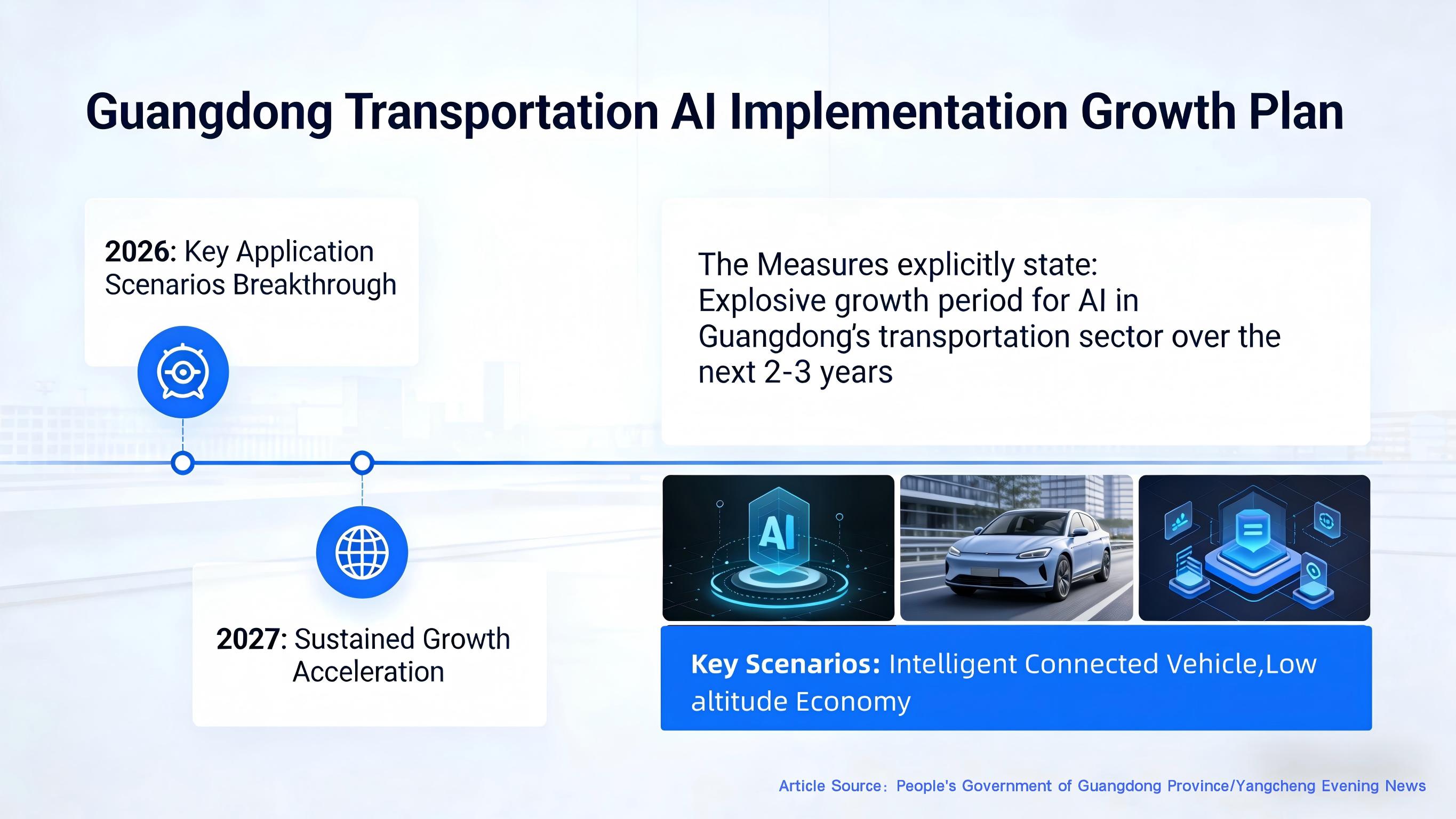
Recently, the General Office of the Guangdong Provincial People's Government officially issued the Several Policy Measures for Guangdong Province to Empower High-Quality Transportation Development with Artificial Intelligence (hereinafter referred to as the Measures), introducing 14 initiatives. This aims to advance development across three dimensions: core element supply, innovation scenario empowerment, and mechanism establishment, marking Guangdong's entry into a new phase of accelerated “AI+Transportation” development. The Measures state that by 2026 and 2027, breakthroughs will be achieved in key application scenarios, signaling an explosive growth period for AI implementation in Guangdong's transportation sector over the next two to three years.
I. Strengthening Foundations: Enhancing Data, Computing Power and Algorithm Supply
To provide ample “nourishment” for AI applications, the Measures outline clear infrastructure development plans:
1. Strengthening Data Supply: Promote standardized data collection across all elements of highways, railways, ports, and shipping. Launch pilot programs for authorized operation of public data. Accelerate the construction of high-quality datasets for smart road networks and digital port operations.
2. Ensuring Computing Power Networks: Support enterprises in utilizing computing resources from regional clusters like the Shaoguan Data Center, encourage deployment of edge computing nodes on key road sections and ports to form a collaborative computing power system. Simultaneously, promote 5G and BeiDou network coverage to build a low-latency transportation sensing and transmission network.
3. Breakthroughs in Key Technologies: Develop specialized knowledge bases and knowledge graphs for the transportation sector. Accelerate R&D of AI-specific models and intelligent agents to support critical applications such as facility sensing, emergency dispatch, and industry governance.
II. Scenario Implementation: Focusing on Eight Innovative Applications, with Intelligent Connectivity and Low-Altitude Economy as Highlights
The Measures outline eight innovative application scenarios to advance AI technology from “laboratory” to “real-world deployment,” with intelligent connected vehicles and low-altitude economy emerging as new growth drivers.
1. Promoting the large-scale application of intelligent connected vehicles
Ø Six-City Pilot for Mutual Recognition: Pilot the “Golden Inner Bay” cities (Guangzhou, Shenzhen, Zhuhai, Foshan, Dongguan, Zhongshan) to promote cross-city connectivity of test roads, achieve mutual recognition of test results and licenses, and gradually expand province-wide.
Ø Building “Vehicle-Road-Cloud Integration”: Support Guangzhou and Shenzhen in establishing national pilot cities for “Vehicle-Road-Cloud Integration” applications in intelligent connected vehicles.
Ø Exploring Commercial Scenarios: Support commercial applications of unmanned heavy trucks in scenarios such as multimodal transport and dedicated line logistics; support platooning tests for trucks on major corridors in scenarios like port collection and distribution and logistics parks, promoting the integrated development of unmanned driving and new energy heavy trucks.
2. Expanding New Low-Altitude Economy Scenarios
Ø Enhancing Service Systems: Advance province-wide low-altitude flight service support systems, exploring AI applications in airspace management and emergency coordination.
Ø Promote Collaborative Integration: Encourage AI-driven data fusion with drones to expand applications in road patrols, emergency rescue, and other scenarios, fostering synergy between drones and smart highway systems.
Ø Explore Multi-Device Coordination: Investigate collaborative applications involving unmanned systems such as drones, autonomous vehicles, and unmanned vessels.
3. Upgrade Smart Transportation and Infrastructure
Ø Smart Transportation Services: Leverage the “Single Window” platform to facilitate cross-border freight data connectivity and enhance logistics efficiency. Promote smart parcel delivery at the last mile for postal and express services. Pilot unmanned logistics vehicle testing and operation on open roads in Guangzhou, Shenzhen, Shantou, and Jieyang.
Ø Smart Highways and Railways: Explore the “digital surveying + digital design + smart construction” model. Utilize AI root-cause analysis for traffic congestion. Upgrade rail transit from “disparate operations” to “smart integrated transport,” leveraging large models to optimize passenger flow forecasting and capacity allocation.
Ø Smart Port and Shipping: Create a unified map for comprehensive waterway monitoring. Pilot a “vessel-shore-cloud” collaborative ecosystem at Guangzhou Port, enhancing navigation safety through machine vision and collision-avoidance algorithms.
III. Mechanism Safeguards: Reinforcing Accountability to Ensure Effective Implementation
To guarantee the effective implementation of all measures, Guangdong has established robust safeguards:
1. Clarifying Responsible Entities: Reinforcing the principle of “managing industries entails managing AI applications,” the Provincial Department of Transportation leads the establishment of an “AI+Transportation” task force, with phased breakthrough targets set for 2026 and 2027.
2. Strengthening Collaborative Innovation: Transport infrastructure tech projects should, in principle, integrate AI applications. A coordination platform will be built to optimize the industrial ecosystem and strengthen multidisciplinary talent development.
3. Fortifying Safety Foundations: Establish a tiered application security management system, strengthen network and data security compliance, refine data classification and privacy protection, and address potential AI application risks.
