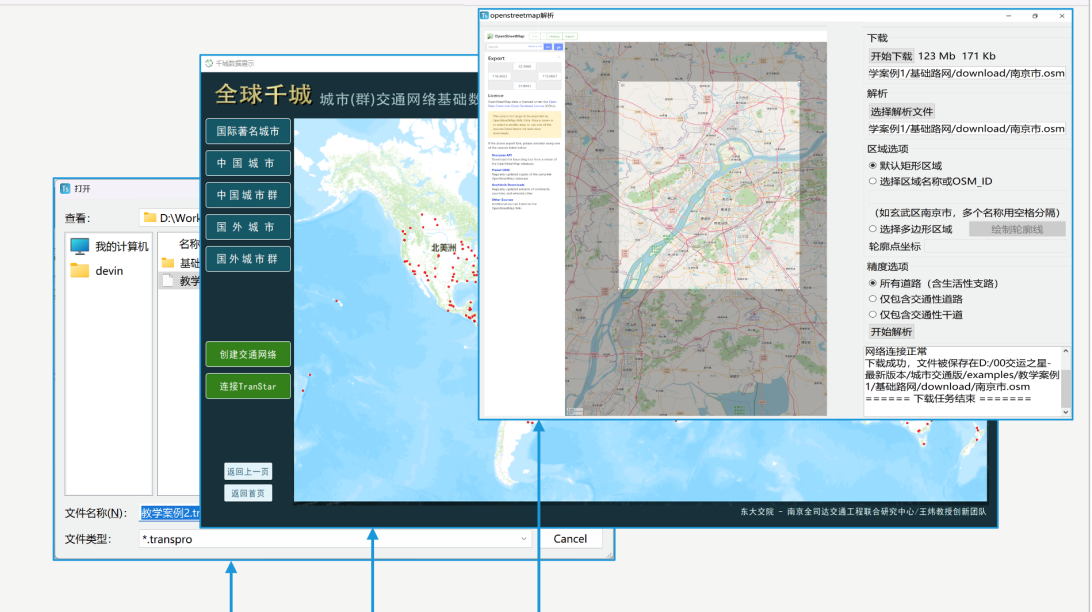

The SEU-TranStar Joint Research Center is a premier collaborative innovation platform established by the School of Transportation at Southeast University (SEU) and Nanjing TranStar Transportation Technology Co., Ltd., dedicated to the deep integration of industry, academia, and research. The School of Transportation at SEU is widely recognized as a national leader in transportation engineering. It hosts a Double First-Class discipline and holds an A+ rating in China’s official subject evaluation. With a strong research heritage and a distinguished faculty, the school has built lasting strengths in transportation planning, traffic management, and intelligent transportation systems. Nanjing TranStar brings extensive practical experience and proven R&D capacity, with established expertise in transportation informatics and simulation-based decision support.
Leveraging this synergy, the Center focuses on key technologies in traffic system modeling and decision support. Its flagship solution, the TranStar platform, has evolved over 30 years. Covering Urban Transportation Edition, Comprehensive Transportation Edition, and AI-driven Transportation Large Model, it provides critical support for demand forecasting, network optimization, and emergency management. Looking ahead, the Center is committed to providing government authorities and industry clients with comprehensive consulting and technical services, driving the digitization, refinement, and intelligence of modern transportation systems.
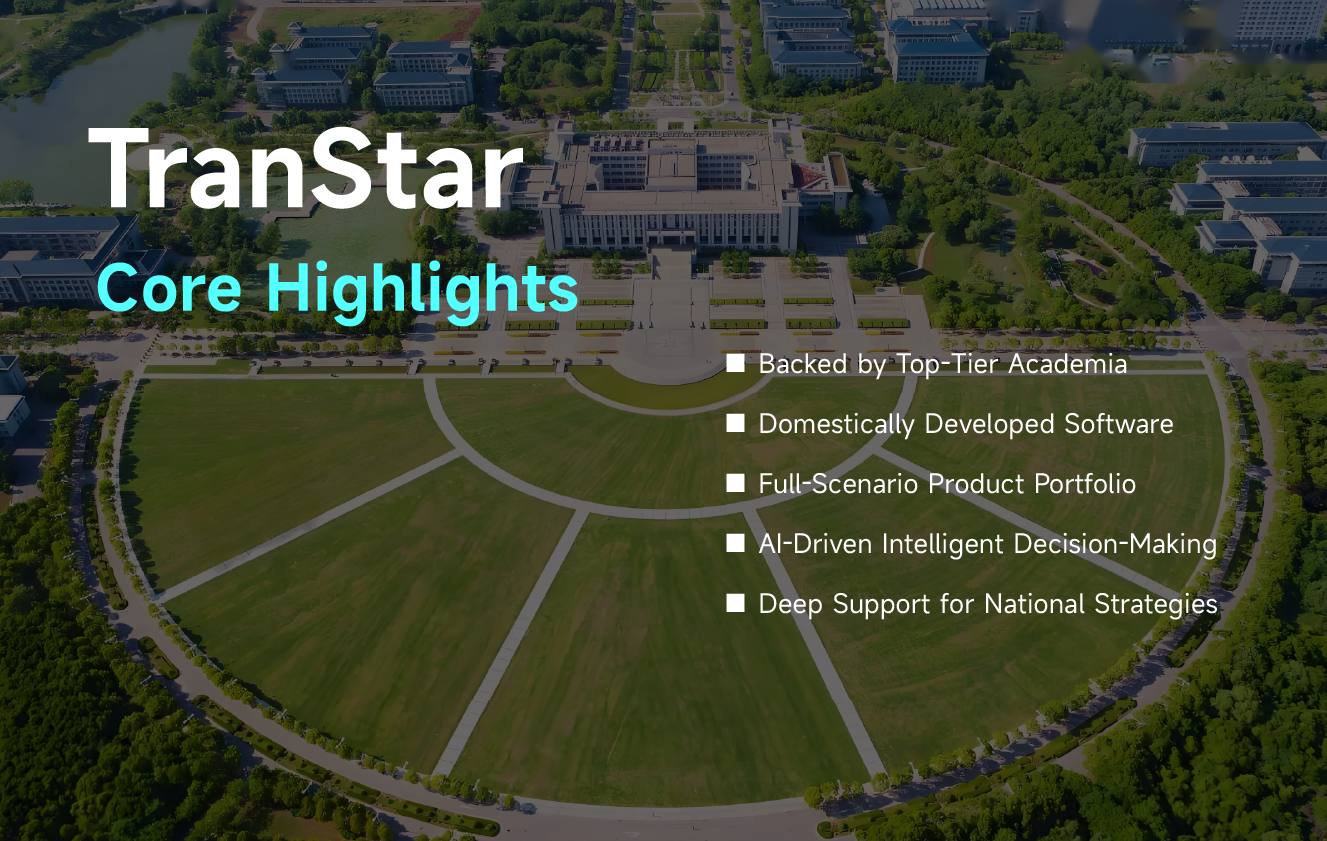
TranStar – Urban Transportation Edition
TranStar – Urban Transportation Edition is one of the few domestically developed transportation analysis software systems in China with fully independent intellectual property rights. It is also currently the only Chinese simulation platform capable of competing with leading international traffic analysis software.
With TranStar, users can quickly understand the operational status of urban transportation systems, diagnose existing problems, and evaluate the potential impacts of planning and design projects. The platform enables multi-source integration of fundamental data, hierarchical representation of network structures, integrated system functions, quantitative data analytics, visualized outputs, and real-time human–computer interaction.
TranStar effectively supports urban traffic problem-solving, assists in the formulation of transportation planning schemes, and provides comprehensive support for the development of future smart transportation systems. It serves as a fundamental .
n Key Features:
1. Multi-source data processing (RFID, GPS, travel surveys)
2. OSM+ rapid network construction — metropolitan networks in seconds
3. Automatic TAZ delineation based on population, lighting, and network topology
4. Three core analysis modules: demand forecasting, public transport analysis, traffic operation analysis
5. One-click workflow for non-specialists — supports micro-circulation, one-way streets, bus lane design
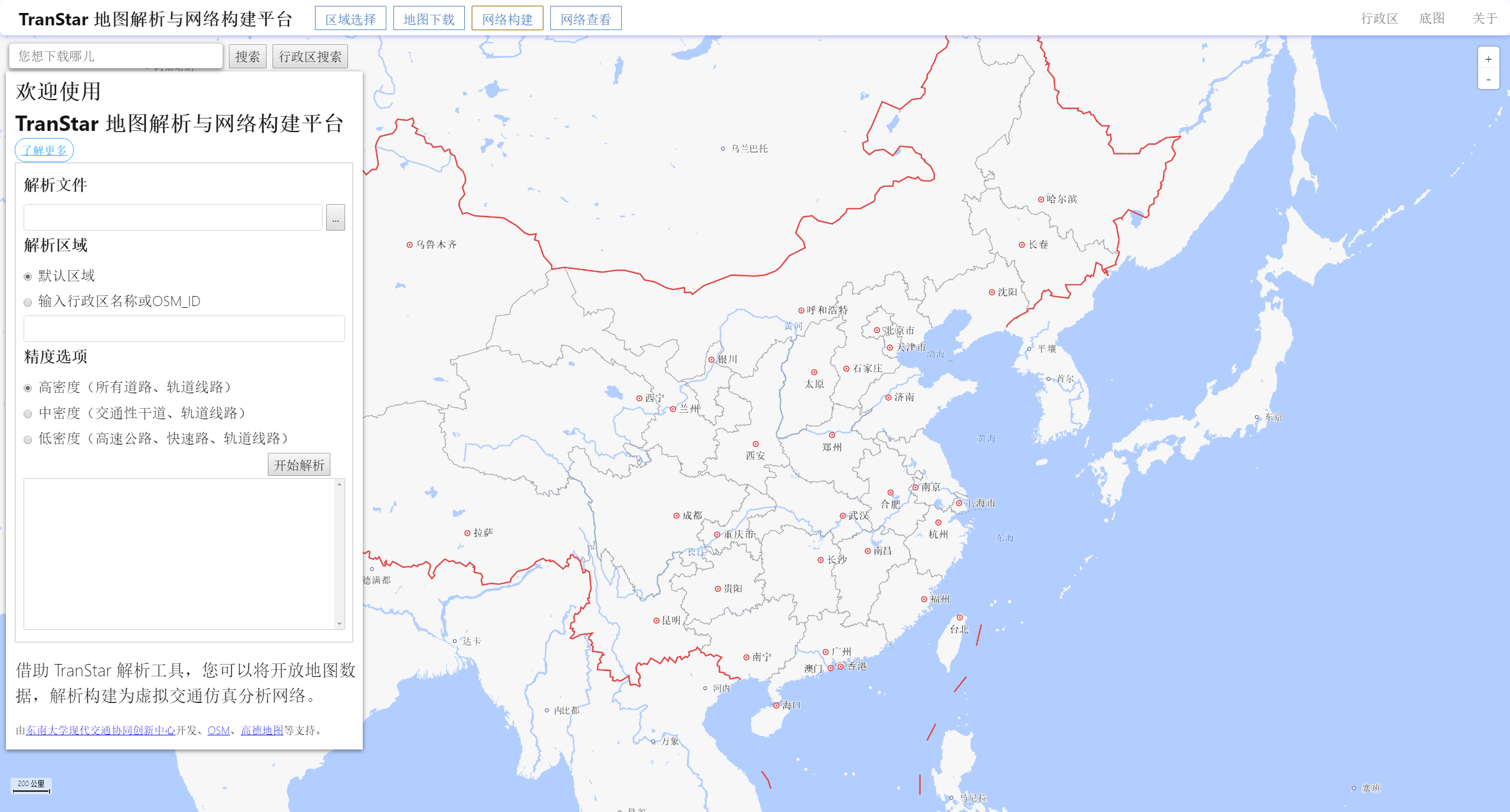
TranStar – Comprehensive Transportation Edition
TranStar – Comprehensive Transportation Edition is a simulation and analytical platform designed for regional and urban agglomeration–level comprehensive transportation systems. Built upon a comprehensive transportation database, the software provides powerful modeling, simulation, and evaluation capabilities.
The platform is applicable to comprehensive network planning for regions and metropolitan clusters, feasibility studies of transportation engineering projects, project appraisal, and multi-network traffic management. A business-oriented one-click simulation environment is provided to generate detailed analytical and evaluation outputs for planning, design, construction, management, and control tasks across a wide range of applications.
n Key Features:
1. Multimodal Integration: Standardizes and integrates multi-source heterogeneous data to rapidly build and accurately integrate transportation networks covering road, rail, waterway, aviation, and pipelines.
2. Integrated Quantification: Establishes a supply–demand balance modeling framework for coordinated transportation networks, supporting quantitative analysis of intermodal passenger travel and multimodal freight transport.
3. End-to-End Coordination: Provides six analytical modules, including network acquisition, structural analysis, system demand analysis, system operation analysis, scenario-based analysis, and quantitative evaluation.
4. Multi-Scenario Applications: Supports integrated passenger and freight transport analysis and specialized network studies, contributing to the development of integrated transportation networks, multimodal passenger hubs, and modern metropolitan areas.
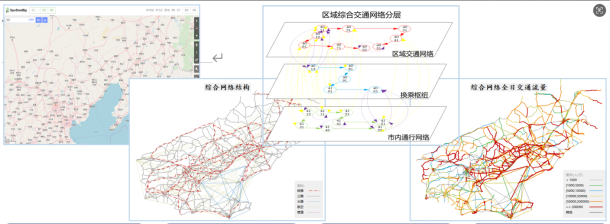
TranStar – Transportation Large Model
TranStar – Transportation Large Model (TLM) Edition focuses on six key domains: urban renewal and governance, transportation infrastructure planning and construction, public transport operations and organization, road traffic management and control, external comprehensive transportation, and transportation policy evaluation.
Through deep integration with large language models, the platform builds an end-to-end intelligent decision-making system that spans AI-assisted solution design, multi-source data matching and fusion, multi-agent collaborative traffic simulation, and system evaluation with automatic report generation.
The full workflow supports multi-round dialogue, contextual reasoning, automated task execution, and iterative scenario optimization. It provides intuitive operations for non-specialists while meeting the advanced analytical requirements of professionals, empowering users at different levels to perform intelligent transportation decision-making.
n Key Features
1. Natural language input — turn vague requirements into structured tasks
2. Six core domains: urban renewal, infrastructure planning, public transport operations, traffic management, external transportation, policy evaluation
3. Multi-agent collaboration — AI agents handle data acquisition, modeling, simulation, evaluation, and visualization
4. Multi-scale evaluation — from traveler efficiency to network performance, energy consumption, and economic benefits
5. Automated report generation — text, charts, and indicators with AI-assisted customization
6. Self-evolving system — identifies bottlenecks, recommends optimizations, and continuously updates scenarios and strategies